Ebook Thinking and Deciding, 4th Edition, by Jonathan Baron
By visiting this web page, you have actually done the ideal gazing point. This is your begin to pick guide Thinking And Deciding, 4th Edition, By Jonathan Baron that you really want. There are great deals of referred books to read. When you intend to obtain this Thinking And Deciding, 4th Edition, By Jonathan Baron as your publication reading, you can click the link page to download and install Thinking And Deciding, 4th Edition, By Jonathan Baron In couple of time, you have actually possessed your referred e-books as all yours.
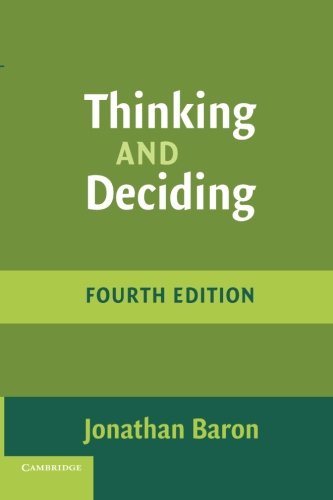
Thinking and Deciding, 4th Edition, by Jonathan Baron

Ebook Thinking and Deciding, 4th Edition, by Jonathan Baron
Thinking And Deciding, 4th Edition, By Jonathan Baron. Haggling with reviewing behavior is no requirement. Reviewing Thinking And Deciding, 4th Edition, By Jonathan Baron is not type of something sold that you can take or otherwise. It is a point that will transform your life to life much better. It is the thing that will certainly offer you several things worldwide as well as this cosmos, in the real world and below after. As what will be given by this Thinking And Deciding, 4th Edition, By Jonathan Baron, just how can you negotiate with things that has numerous benefits for you?
It is not secret when hooking up the writing skills to reading. Reading Thinking And Deciding, 4th Edition, By Jonathan Baron will certainly make you get more sources and also resources. It is a manner in which can enhance how you ignore and recognize the life. By reading this Thinking And Deciding, 4th Edition, By Jonathan Baron, you can more than exactly what you obtain from various other book Thinking And Deciding, 4th Edition, By Jonathan Baron This is a widely known book that is released from famous publisher. Seen form the writer, it can be trusted that this book Thinking And Deciding, 4th Edition, By Jonathan Baron will offer numerous inspirations, concerning the life as well as experience and also every little thing within.
You might not should be uncertainty regarding this Thinking And Deciding, 4th Edition, By Jonathan Baron It is easy method to get this book Thinking And Deciding, 4th Edition, By Jonathan Baron You can simply visit the distinguished with the web link that we supply. Here, you can buy the book Thinking And Deciding, 4th Edition, By Jonathan Baron by on-line. By downloading and install Thinking And Deciding, 4th Edition, By Jonathan Baron, you can discover the soft documents of this book. This is the exact time for you to begin reading. Even this is not printed book Thinking And Deciding, 4th Edition, By Jonathan Baron; it will exactly offer even more advantages. Why? You could not bring the printed publication Thinking And Deciding, 4th Edition, By Jonathan Baron or only pile guide in your residence or the workplace.
You can carefully include the soft file Thinking And Deciding, 4th Edition, By Jonathan Baron to the gizmo or every computer unit in your office or house. It will help you to still proceed reading Thinking And Deciding, 4th Edition, By Jonathan Baron whenever you have downtime. This is why, reading this Thinking And Deciding, 4th Edition, By Jonathan Baron does not give you issues. It will certainly give you essential resources for you that intend to start creating, discussing the similar publication Thinking And Deciding, 4th Edition, By Jonathan Baron are various publication field.
Beginning with its first edition and through subsequent editions, Thinking and Deciding has established itself as the required text and important reference work for students and scholars of human cognition and rationality. In this, the fourth edition, Jonathan Baron retains the comprehensive attention to the key questions addressed in the previous editions - How should we think? What, if anything, keeps us from thinking that way? How can we improve our thinking and decision making? - and his expanded treatment of topics such as risk, utilitarianism, Baye's theorem, and moral thinking. With the student in mind, the fourth edition emphasizes the development of an understanding of the fundamental concepts in judgment and decision making. This book is essential reading for students and scholars in judgment and decision making and related fields, including psychology, economics, law, medicine, and business.
- Sales Rank: #138107 in Books
- Brand: Brand: Cambridge University Press
- Published on: 2007-10-22
- Released on: 2007-12-20
- Original language: English
- Number of items: 1
- Dimensions: 8.98" h x 1.50" w x 5.98" l, 1.70 pounds
- Binding: Paperback
- 600 pages
Features
- Used Book in Good Condition
Review
"... An impressively broad and serious guide to the psychology of thinking and deciding." Choice
"This volume represents an impressive textbook that is worthy of consideration in courses on thinking and decision making. ... Well written and well produced." - Contemporary Psychology
"Baron has taken on the task of examining in detail the full range and diversity of psychological research which helps him and us to understand the nature of thinking as he sees it, and to explore its application to teaching. It is a heroic effort, and thoroughly recommended." Times Higher Education Supplement
"This magisterial book ... lays out the issues in exemplary fashion ... . This book is as balanced and clear as one is likely to find. It is an outstanding introduction to and summary of the psychology of decision making and should be widely read." Medical Decision Making
About the Author
Jonathan Baron is Professor of Psychology at the University of Pennsylvania. Baron's research is based on the utilitarian idea that society should be organized to do the most good (or to maximize utility). Some of his research examines people's intuitive principles for decision-making and moral judgement, and explores how these principles can stand in the way of doing the most good. Baron is the author of Rationality and Intelligence (1985); Thinking and Deciding (1988, 1994, 2000), a widely used textbook for advanced undergraduates and beyond; Morality and Rational Choice (1993), Judgement Misguided: Intuition and Error in Public Decision Making (1998); and Against Bioethics (2006). He has also co-edited three books and published over 175 papers and chapters. He is the editor of the journal Judgement and Decision Making, and he is currently president of the Society for Judgement and Decision Making. He holds a BA from Harvard and a PhD from Michigan and is a Fellow of the American Association for the Advancement of Science and of the American Psychological Society.
Most helpful customer reviews
34 of 35 people found the following review helpful.
An Actively Open-Minded Exposition
By Herbert Gintis
This is the fourth edition of Jonathan Baron's very popular textbook on decision-making and thinking. The text is inspired by, and develops carefully and in an entertaining manner, the basic theories and experimental results of Daniel Kahneman, Amos Tversky, George Loewenstein, Paul Slovic, and others in the "heuristics and biases" tradition. This school of thought is only 35 years old, but it has radically transformed our knowledge of human decision-making. The material is inherently engaging, and students love to study it. This is an excellent book, and fully covers the subject material, except for graduate students who plan to work in this area, who should read the primary material on which this book is based. It is also great for self-study by the curious lay reader.
Let me say at the outset that the negative reviews of this book are totally unwarranted. One is just the ranting of a persons who cannot give reasons, but only throw out unsupported, idiosyncratic, judgments. Another is by a reader with an ax to grind concerning philosophical issues in probability theory that are completely tangential to the purposes of this book I think these commentators would do well to withdraw their useless and diverting comments.
Baron is a talented experimenter in his own right, although in the book he limits his material almost exclusively to the works of the Old Masters, Kahneman et al. His own contribution is on an interpretive level. First, his basic model of human behavior is what he calls the "search-inference" model, which turns out to be the economist's "rational actor" model, in which decision-makers have preferences ("goals" in the search-inference terminology), beliefs, and constraints, and act to maximize utility (goal-attainment) subject ot constraints. Baron defines "rational thinking" as "whatever kind of thinking best helps people achieve their goals." (p. 61) This, of course, is precisely the definition of rationality in the rational actor tradition in decision-theory. Of course, "preferences" are more specific than "goals," and it is not clear to me whether "rational" in Baron's sense includes achieving goals that are welfare-reducing (e.g., substance abuse), whereas in the rational actor tradition, rationality has to do with the attainment of goals with no evaluation of the relationship between goals and personal welfare.
Baron introduces two normative notions which instructors will find useful. The first is the idea of "actively open-minded thinking," and the second is "multi-attribute utility theory." Together, they urge that decision-maker cast a wide net in evaluating alternatives before honing in on a particular choice. The examples illustrating the value of this approach are illuminating and helpful.
This book does not make clear that there has been a second wave of behavioral experiments, starting in the mid-1980's that focus less on isolated decisions, and more on decisions in a setting of strategic interaction, using game theory as a tool of experimental design. This new body of theory and evidence deals with fairness and justice, altruism, cooperation, insider-outsider interactions, and related themes, in a manner barely intimated in this book. The chapters on altruism, fairness, and moral reasoning, are at least fifteen years out of date, and should not be used in a classroom today. There is, of course, plenty of material in the book without using these chapters, for a whole course on decision-making and thinking, but for strategic interaction, cooperation, and conflict, a completely different set of readings are required---and perhaps a completely new course devoted exclusively to this material.
A major focus of this book is on biases in decision-making---human errors that are not simply random, but rather are consistently biased in a particular direction. For instance, in the Draw A Man diagnostic, clinicians systematically interpret big eyes on a patient's drawing as indicative of paranoia, despite the fact that no such statistical relationship has ever been found. Moreover, untrained students also make the same mistake, indicating that this judgment is a systematic error committed by many people. The tragedy is that the clinicians do not abandon their biases when faced with objective data.
While systematic bias is a very important phenomenon, Baron does not claim that the rational actor models used by economists, in which biases do not exist, are contradicted by the experimental evidence---a criticism that the heuristic and bias researchers are usually fond of leveling against economic theory. Rather, he says that effective decision-making is the rule, especially when the parameters of the decision problem are clear, and that we should approach the biases that arise in complex decision contexts as challenges that we can overcome if we have the proper decision-making protocols.
Why do economists ignore biases in decision making, while psychologists take them so seriously? The answer is that economists only care about individual decision-making because they need a model of individual behavior that they can aggregate to model the macro-economy. Moreover, they consider their most fruitful professional interventions not in helping people make better decisions, but rather in advising governments and firms how to manipulate such macroeconomic variables as tax, profit margins, and interest rates. Psychologists, by contrast, consider the individual, not society, as the focus of their ministrations. Hence they tend to ignore the enormous success of the rational actor paradigm in modeling social behavior, and rather focus on areas of vulnerability in individual decision-making, where professional interventions on the level of the individual can improve decision-making accuracy.
64 of 66 people found the following review helpful.
Decisions, decisions, decisions
By John S. Ryan
This is a _very_ impressive book. I can't imagine a more thorough overview of the study of human judgment, decisionmaking, and rationality.
It's hard to find a good single volume in this field. For the psychology of judgment and decisionmaking, there's Scott Plous's excellent book of that title. For the heuristics on which we seem to rely and the biases they seem to generate, there's the modern classic _Judgment Under Uncertainty_ by (the late) Amos Tversky and (recent Nobel prize winner) Daniel Kahneman. And there are other books devoted to special topics and subtopics.
But so far as I know, this is the only broad, general introduction to the entire field of thinking, how we do it, how we probably ought to do it, and the sorts of things we do it about.
The book is divided into three broad sections. "Thinking In General" covers just that: what thinking is, and the nature of rationality and logic. "Probability and Belief" introduces not only probability theory (including, importantly, Bayes's Theorem) but the various theories about what probability _is_, as well as hypothesis testing, correlation, and "actively open-minded thinking." The largest section, "Decisions and Plans," is eleven chapters long and covers everything else: uncertainty, utility, decision analysis, theories of morality fairness, and justice, and risk.
As you might imagine, Baron doesn't leave too many stones unturned. Heck, his bibliography alone is thirty-odd pages long.
The book is eminently readable. The third edition is aimed mainly at graduate students but I gather Baron still uses it in his undergraduate courses. If you're a lay reader interested in this field, you'll be able to read it on your own with no difficulty.
0 of 0 people found the following review helpful.
I learn some new heuristics, biases, and principle ...
By Daniel C
I learned some new heuristics, biases, and principle from the book. The concept of expected utility and utilitarian theory are especailly meaningful to me and have shaped my thinking and weighing tradeoff in decision making.
See all 11 customer reviews...
Thinking and Deciding, 4th Edition, by Jonathan Baron PDF
Thinking and Deciding, 4th Edition, by Jonathan Baron EPub
Thinking and Deciding, 4th Edition, by Jonathan Baron Doc
Thinking and Deciding, 4th Edition, by Jonathan Baron iBooks
Thinking and Deciding, 4th Edition, by Jonathan Baron rtf
Thinking and Deciding, 4th Edition, by Jonathan Baron Mobipocket
Thinking and Deciding, 4th Edition, by Jonathan Baron Kindle
Thinking and Deciding, 4th Edition, by Jonathan Baron PDF
Thinking and Deciding, 4th Edition, by Jonathan Baron PDF
Thinking and Deciding, 4th Edition, by Jonathan Baron PDF
Thinking and Deciding, 4th Edition, by Jonathan Baron PDF